
Data transmitted
- Claim
- SX-2026-04871
- Date
- 14/03/2026
- Vehicle
- Alfa Romeo Stelvio


01 / 06
Ingestion of the claims
Every day the company sends claims to be verified according to its operational criteria: value, geographic area, sampling, and alerts.
01 / 06
Every day the company sends claims to be verified according to its operational criteria: value, geographic area, sampling, and alerts.
02 / 06
The images are stripped of sensitive elements — license plates and faces. DAFNE is interested in the damage, not the identity.

03 / 06
DAFNE identifies and isolates the damage, analyses its shape, extent and typology, and constructs a technical representation comparable over time.
04 / 06
The damage is compared with the company’s archive to reveal recurrences and reuses between claims even distant in time.

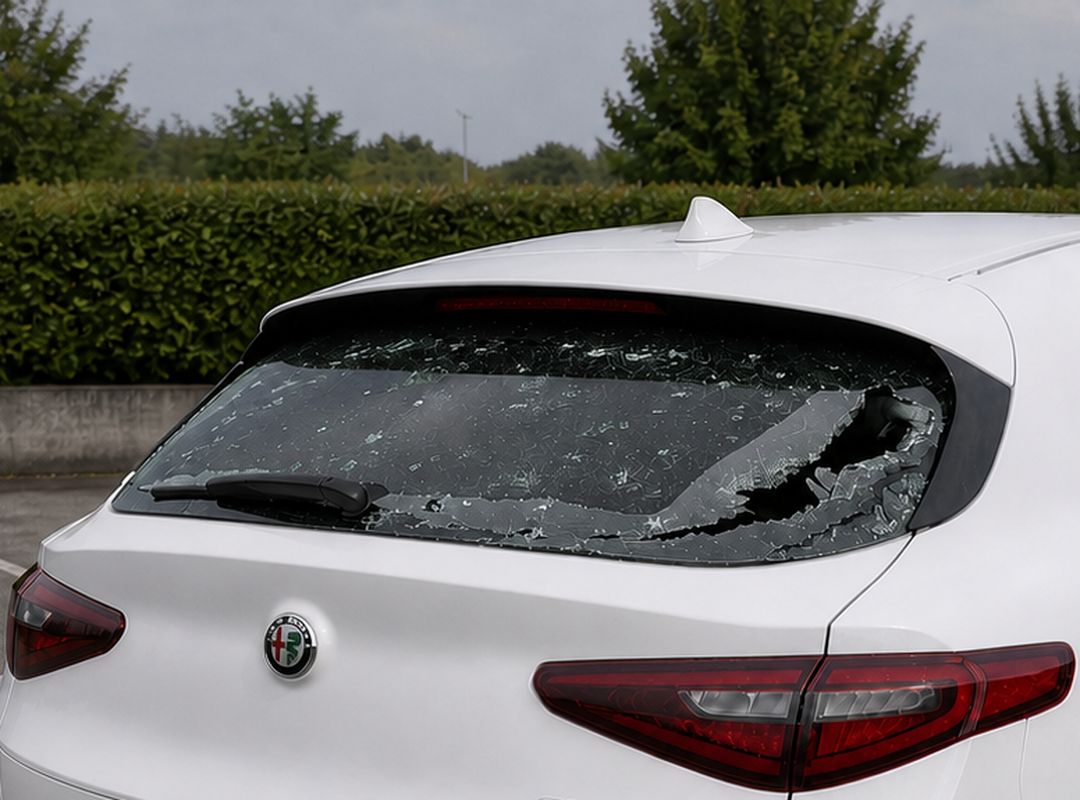
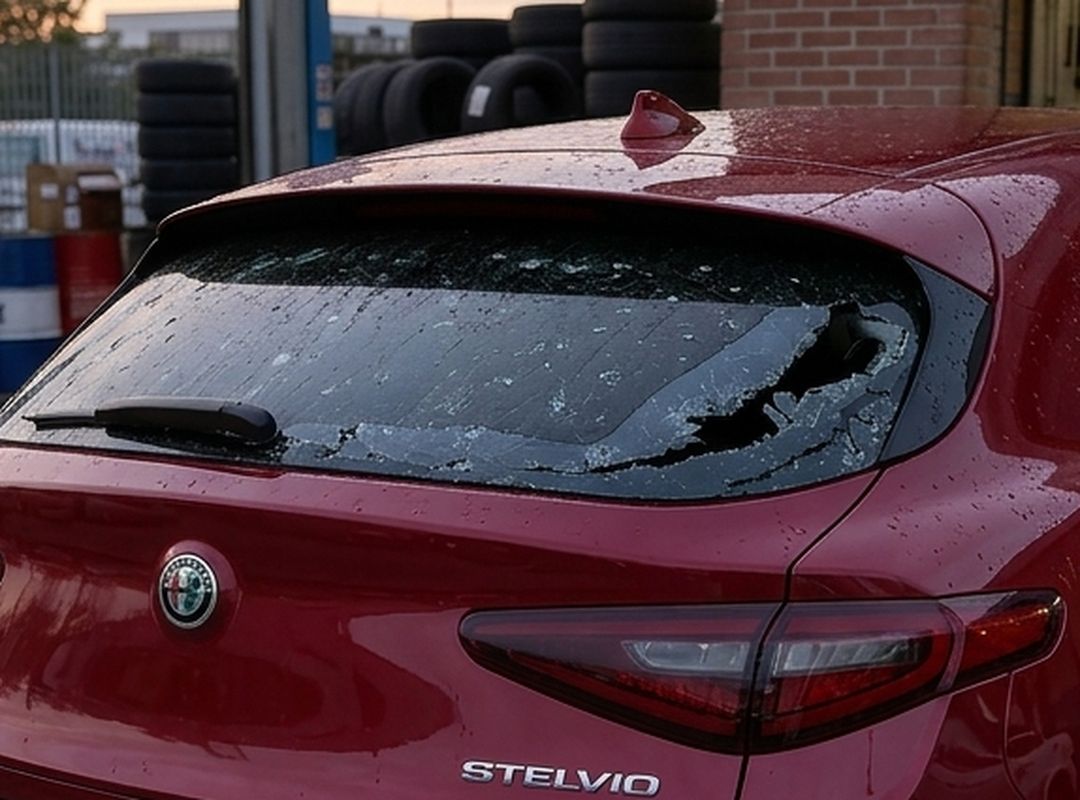
Match confirmed by M. Rossi
05 / 06
High-confidence matches are verified by specialized analysts: false positives are eliminated and the case is confirmed. Human intervention is focused only where necessary.
06 / 06
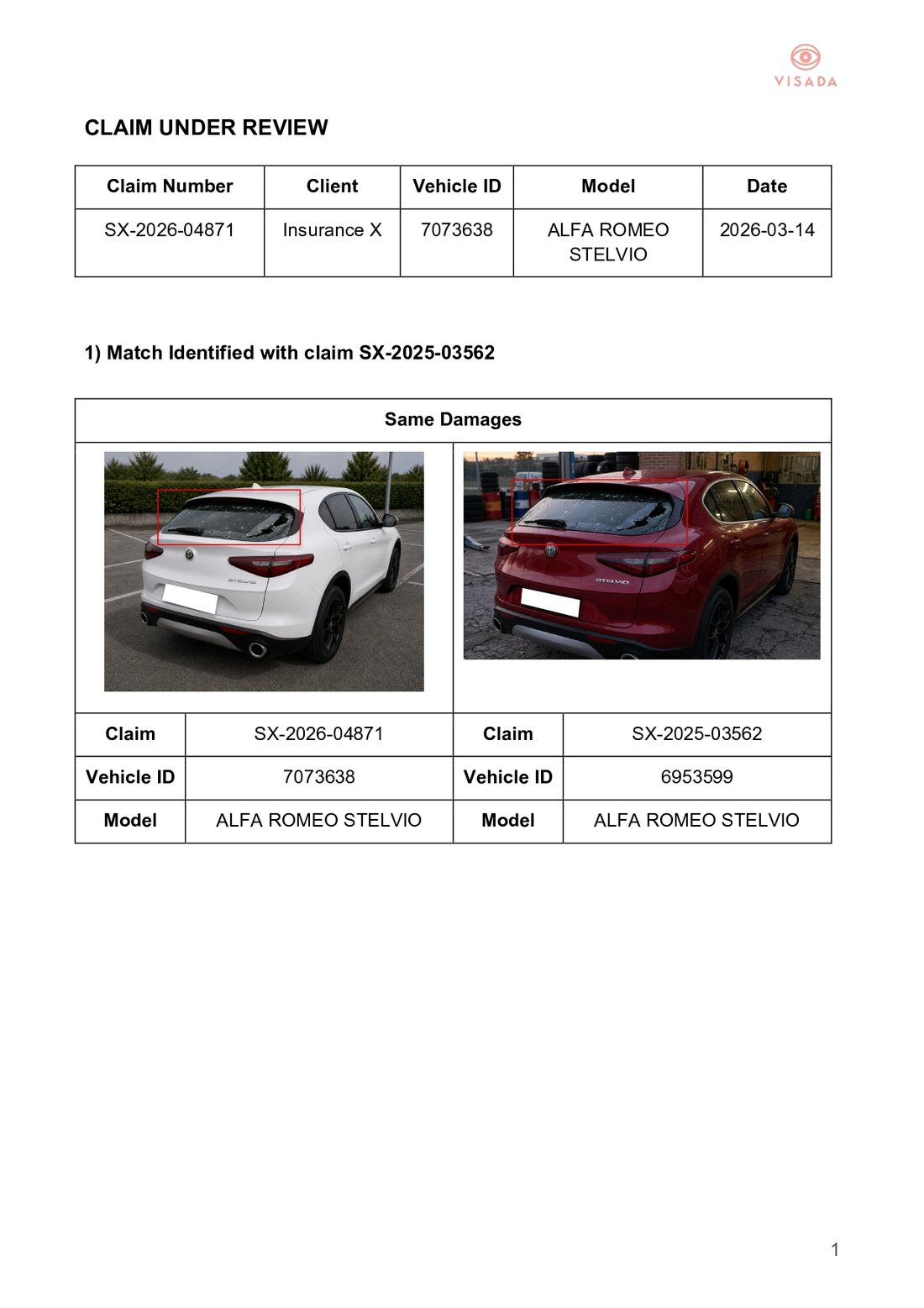
If confirmed, a structured evidence report is produced, with a direct comparison between the damage and traceable references.
Every claim leaves traces. Not only in the declared dynamics, but also in the image pixels, file metadata, and attached documents. DAFNE reads them, correlates them, and compares them with historical records. The four levels do not operate in isolation: the evidence cross-references and reinforces each other. No result is sent to the insurance company until validated by an expert operator.
The same damage, even when everything else changes.
DAFNE compares the visual signature of the damage with the entire archive: it recognizes reused or slightly modified images, already-damaged parts reassembled on different vehicles, crops and copies, and the same vehicle presented with different license plates, even foreign ones.
Each file tells how it was born.
Behind an image lies information the naked eye can’t see: when it was taken, the device used, and whether it has been altered. DAFNE detects discrepancies between the date of the shot and the date of the accident, traces of editing, images generated or retouched using artificial intelligence, and inconsistencies within the metadata chain.
The paper also has cracks.
Estimates, invoices, forms, and appraisals can contain anomalies that are difficult to detect manually. DAFNE detects changed headers, fictitious names and contact details, recurring phone numbers in seemingly unrelated cases, and reused documents with minor variations from one claim to the next.
The claim in its context.
Thanks to the partnership with LambdAI Space, the analysis can extend beyond the vehicle to include buildings, roofs, and outdoor areas. A particularly useful tool in property lines, where photographic documentation is often partial and acquired only after the event.
Digital Anti-Fraud Neural Engine
DAFNE does not assign abstract scores or probabilistic indicators: it builds a technical representation of the damage, compares it with the company’s history and produces verifiable visual evidence. The process is designed to be continuous, scalable and traceable, from activation to daily use.
Construction of the historical base
To identify damage already submitted in the past, it is necessary to start from historical data. At the start of the collaboration, DAFNE analyzes a set of previous claims deemed relevant by the company, typically two to five years of images: it anonymizes, isolates and indexes each damage in the VISADA database. Thanks to a batch workflow optimized to run in parallel, processing is completed in just a few days. At the end, the system is ready to detect fraud.
Daily use
On a daily basis, the company sends mass claims to be verified according to its own rules: value, geographic area, sampling, alerts. Each image goes through the six-step pipeline: anonymization, damage analysis, matching with the historical data, human validation of high-confidence matches and a report only when confirmed.
Operational evidence report
Not a simple alert or an abstract risk score: an evidence report designed for operational use, with a direct visual comparison between the claim being analyzed and the related cases, targeted crops of the damage areas and clear identification and timestamps. Anti-fraud and claims settlement teams receive documented, actionable output that can also be used in more formal contexts.
Every report is reasoned, traceable and understandable even by non-technical specialists. It can support the rejection of a claim or be used in a dispute.
An expert operator verifies every match: the output remains reliable and defensible, even during internal audits or reviews. DAFNE does not replace experts and anti-fraud teams, it empowers them.
License plates and faces are removed by design. At the start of the collaboration we propose a Data Protection Impact Assessment that already includes the DAFNE use case.
Reduced fraud costs, more efficient anti-fraud teams, faster pre-settlement. Each project is accompanied by clear and verifiable metrics.

Who’s behind it
Visada builds technology for the claims world. We build DAFNE together with the insurance companies that use it every day.
Best Insurtech 2026F.A.Q.
The answers we give most often to anti-fraud, claims and DPO teams. Can’t find yours? Write to info@visada.ai.
DAFNE is VISADA’s artificial intelligence system that analyzes claim images to identify recurring damage and potential fraud.
It does on a large scale what today only an expert can recognize on a case-by-case basis: it compares the damage, correlates it with the historical data and produces objective and measurable evidence.
No. DAFNE does not replace experts or anti-fraud teams.
It is a solution designed for insurance companies that supports internal teams, providing evidence and reports that experts can use to make faster and more informed decisions.
DAFNE analyzes claim images to identify repeated, reused, or inconsistent damage between different claims, even over time or on different vehicles. It is particularly effective in cases where the damage is recognizable to a human expert, but impossible to intercept manually on large volumes.
In particular, DAFNE identifies:
In these cases, DAFNE transforms seemingly legitimate images into comparable and verifiable evidence.
Because the difficulty is not seeing the damage, but remembering it, comparing it, and connecting it on a large scale.
An anti-fraud team can identify an anomaly on a single claim. DAFNE does this across tens of thousands of claims, consistently and continuously, tirelessly, without bias, and without losing historical memory.
No. DAFNE does not issue verdicts or make automatic decisions.
It produces reasoned and traceable reports based on objective and verifiable evidence, understandable even by non-technical specialists. This makes the decision-making process faster and more effective and facilitates stopping the fraud within the insurance company’s anti-fraud processes.
DAFNE is trained on large volumes of real-world data and is constantly monitored.
Each report is verified by an expert operator before being delivered: this ensures that, even in the presence of AI errors, the output remains reliable, verifiable, and defensible, even during internal audits or reviews.
Results come immediately.
At the start of the collaboration, the insurance company provides a history of claim images (typically from the last 2–5 years). This history is analyzed and indexed by DAFNE within a few days. This way, each new claim is immediately compared with the historical data, making the system effective from the very first stages of use.
Over time, its value grows further as the number of cases analyzed and relationships identified increases.
Yes. DAFNE is designed to operate in compliance with current regulations, with particular attention to data minimization, security, traceability, and process auditability.
By design, we remove identifying elements such as license plates and faces from the images, because the analysis focuses exclusively on the damage and not the subject.
From a procedural standpoint, at the start of the collaboration we propose a DPIA (Data Protection Impact Assessment) that already includes the DAFNE use case, to support the company in correctly framing the system in accordance with the regulatory framework.
Value is measured in reduced fraud costs, increased efficiency of anti-fraud teams, and better resource allocation.
DAFNE also helps speed up pre-settlement processes, reducing the overall risk on the claims portfolio. Furthermore, the system’s output provides more robust evidence, which can be used both to support the rejection of a compensation claim and, when necessary, in disputes or legal proceedings.
Each project is accompanied by clear and verifiable metrics, shared with the company.
Because insurance fraud has a real cost that falls on everyone, in the form of higher premiums.
Making anti-fraud analysis more effective means reducing waste, limiting incorrect behavior, and contributing to a fairer insurance system, where costs are not passed on to those who behave correctly.
Find out how DAFNE analyzes claims, identifies anomalies, and provides validated evidence that can be directly used by anti-fraud teams. Enter your email address: our team will contact you to arrange a dedicated demonstration.
Or write to info@visada.ai